Thursday, May 20, 2010

What is Google TV?


Today at Google I/O, the company made the announcement that everyone was waiting for — Google TV. While some glitches in the demo (with the Bluetooth keyboard) prevented it from being a “wow” moment, the implications are pretty clear what Google is going for. That is, the 4 billion TV users worldwide. Or rather, advertising to the 4 billion TV users worldwide.

Google noted that while computer usage is huge with 1 billion users, and mobile is even bigger with 2 billion users, TV is the real massive medium with 4 billion users around the world. Further, Google notes that people spend 5 hours a day on average in the U.S. watching TV — and that’s more than ever before. Then the real stat came out. 70 billion dollars. that’s the annual ad spend on television in U.S. alone.

Video should be consumed on the biggest, best, and brightest screen in your house, Google says. And while they’re not the first to attempt this, Google thinks they can get it right. There are four things they’re focusing on:

  • With Google TV, you’ll spend less time finding, more time watching
  • We’ll also show you more ways to personalize content
  • We’ll make existing TV much more interesting
  • This is much more than a TV

“TV meets web. Web meets TV” is the slogan Google is going with for this new endeavor. It will work as a new box — you’ll just hook up your existing cable or satellite box to it. All the hardware will include a keyboard and a mouse — but it will work with Android phones too. And you can use multiple Android devices to control the same TV — no more fighting over the remote.

You can also use the Android devices to speak to your TV — voice search on the TV.

Google TV is built on Android (2.1 right now, but they’ll upgrade it later). It runs Google Chrome for the browser. And yes, it has Flash (10.1).

Also cool, since Google TV is Android-powered, Android apps will work on the TV. With the device, there will be two app frameworks: web apps and Android apps. A new SDK for the Google TV is coming as well. And YouTube has a new product they’re launching for Google TV: YouTube Leanback — this is an optimized way to use YouTube on a big screen.

Google TV will be open sourced in both the Android and Chrome source trees.

Google has partnered with multiple device makers to bring the product to market. There will be three Google TV devices. Sony will have TVs and Blu-ray players with Google TV built in. Logitech will have a companion box. Intel will be powering all the devices with the Atom processor.

Google has also partnered with Dish Network — there will be an enhanced Google TV experience with it. And they have a retail partnership with Best Buy.

These will all launch in Fall 2010. But the platform won’t launch for developers until 2011.

As a bonus, as Google showed during its demo, Google TV is one hell of a way to search for “MILFs” from your couch.

Friday, April 16, 2010

Tips for writing a blog

When i started blogging i knew like what to do but then just to make it clear i started surfing about tips for making a good blog and i came across many things and the below are few best points that i came across.Just have a glance if you are new to blogging and its just a "turnback to the basics"


  • Long, thoughtful, provoking and inspiring articles – every now and then. You don’t want to overwhelm your blog followers with three or four blog posts a week that span several screen lengths. But once in a blue moon – go for it!

  • Short thoughtful, provoking, and inspiring articles – get the difference? You don’t have to write a novel. Just a paragraph or two.

  • ”How-to’s” – 3 steps, 5 secrets, 3 tips types of articles. For example, three things you need to pack for a day-long hike. Or five must-haves in your make-up kit.

  • Quotes – yours or others. You can just post the quotation, or you can explain why this particular quotation is particularly inspiring to you.

  • Resources – this is where you share your favorite things: books, tools, other coaches/consultants/experts.

  • Quick stories about something that happened to you that highlights a perspective you believe in.

  • Poems or songs about your movement that would be inspiring to your tribe

  • Events you are offering/leading – yes, you can even post sales-type posts in your blog. (Which is really handy when you have your blog linked to social networks.)

  • Stories about your friends – their shifts, aha’s, awarenesses, why they work with you, results, profiles. Stories show what you do, much better than you just telling what it is you do.

  • Updates, feedback, buzz about events you are leading, such as “The top 3 questions I’m getting from my friends...”

  • Stories, themes or trends you are seeing with your mates/colleagues.

  • Free checklists - you probably have all kinds of “get started quick” type of lists – use these as special blog postings to generate credibility and expertise

  • Any events where you are appearing, being interviewed, telesummits, and the like. Let people see what you’re doing!

  • Photos – photos – photos! They are inspiring! Of you, your surroundings, your clients, people you are with, you and your mentors.

Simple Science -- Refraction

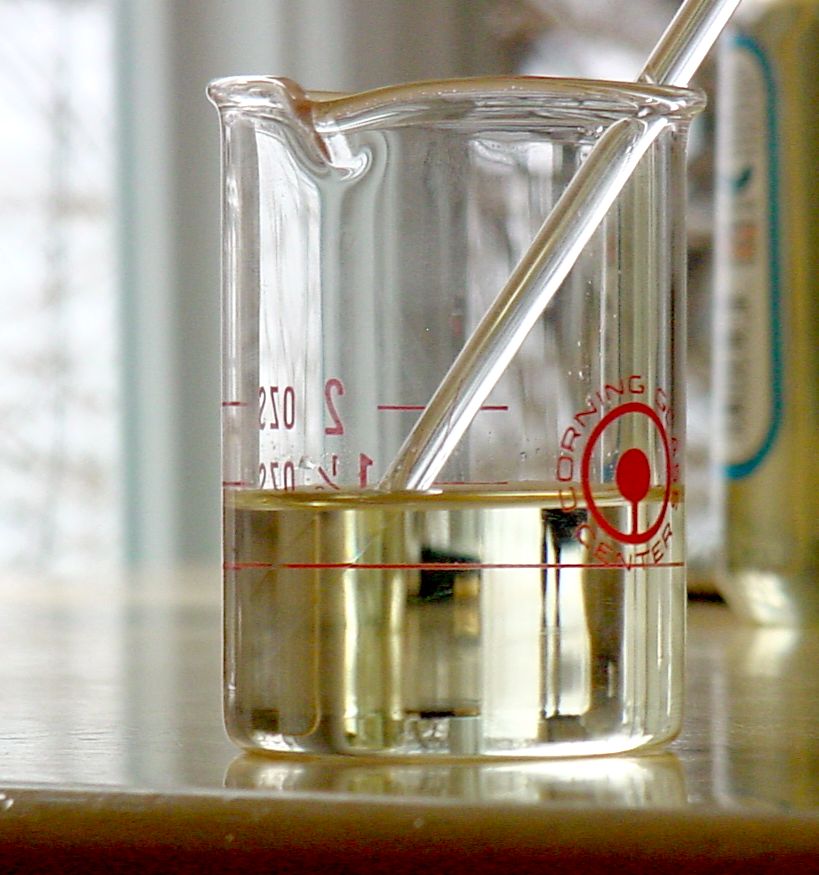
I wanted to make glass disappear in a liquid . I was just browsing about it and found the way.This simple video shows how the glass gets disappeared inside the liquid.


Step 1:


Get a glass rod made from pyrex. This was the hardest part. I got one from the high school chemistry department. Using hollow glass objects like test tubes and pipets and eye-droppers isn't as impressive. The double wall nature of these objects makes it more than twice as hard to make the object disappear. Plus having a glass rod results in a simple test to see if your liquid's index of refraction is too high or too low (explained below in step 4). Pyrex has a low IOR compared to other glasses. Fortunately it is a very common glass. Most glass blown decorations are also pyrex so you could try one of those if you have one.


Step 2:


Pick two liquids that can be mixed together . One with an index of refraction higher than glass and one lower.Baby Oil's IOR is slightly lower than glass. Oil is slightly higher.You only have to mix for 10-30 seconds before testing. It requires 1 to 3 minutes each time you add a drop of water. Also it gets bubbles in it easily and they take 30-60 minutes to reach the surface and pop.


Step 3:


Next is to find a suitable transparent container and put a horizontal line on it or behind it for testing purposes.


Step 4:


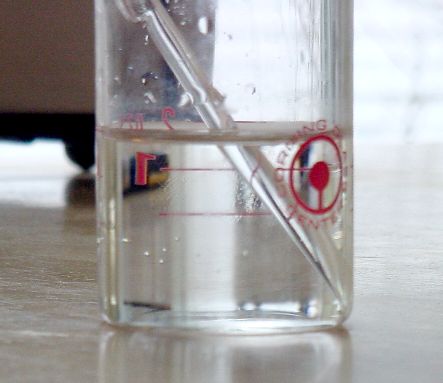
Testing! Put your liquid in your container, insert glass rod. Hold rod vertically and tilt it to the left or the right. If the horizontal line tilts in the same direction, then the index of refraction of the liquid is too low. Water is a good example of this. Here is a picture with water - note that the red line is angled roughly twice that of the rod but in the same direction. If the line tilts in the opposite direction your IOR is too high. As you get close, the tilt is very subtle and you have to look at the edges, tilt the rod more, or hold the rod farther from the horizontal line (towards the front of the container).


Step 5:


Mixing - obviously steps 4 and 5 are repeated alot to get it perfect.If you add too much water (easy to do) and your container is getting too full, put this mixture aside and use it instead of water next time. The mixing goes much faster because the difference in IOR between the two liquids isn't as dramatic.

TEMPERATURE! - I've read that temperature will affect IOR so make sure you do your testing with the liquids at room temperature or at the temperature which they will be used. This goes for your glass also.


Tuesday, April 13, 2010

Simple Science -- Magic Sand


Magic
sand is ordinary sand which has been coated with trimethylsilanol, a compound which makes the sand resistant to water. The result is a hydrophobic sand which can be used in all sorts of interesting ways. Magic sand was originally developed for use in the cleanup of oil spills, but it has come to be used as a children's toy and educational tool instead. Many stores which sell science-orientated kid's toys stock magic sand.


Because magic sand resists water, it performs very strangely when it is exposed to water. Individual grains of sand tend to stick together in the water, creating blocks of sand underwater which can be molded into various shapes. When scattered lightly across the surface of water, magic sand will stick together and form a thin layer of sand which eventually get too heavy to float, sinking slowly to the bottom. Magic sand also appears slightly silvery underwater, thanks to the bubble of air which forms around the granules of sand.


When lifted out of the water, magic sand is perfectly dry and free-flowing. People who grew up playing with magic sand may remember how mesmerizing the mysterious substance was, as the seemingly solid underwater shapes would dissolve instantly when pulled out of the water.


The idea behind this sand when it was initially developed was that it could be scattered across an oil spill to bond to the oil. As the sand bonded with the oil and to itself, it would grow extremely heavy, eventually sinking to the bottom of the ocean and taking the oil with it. However, magic sand proved expensive to manufacture, and doubts were raised about the environmental soundness of this cleanup method.As a result of its commercial failure, the manufacturer was left wondering what to do with its new invention. The solution was to dye the sand in eye-catching colors, label it “magic sand,” “Mars sand,” or “space sand,” and sell it as a toy. Magic sand was immensely popular in the 1980s, much to the chagrin of parents who had to clean up after their children, and it continues to be used in scientific demonstrations of the properties of hydrophobic materials.

You can make magic sand at home, should you feel so inclined. Magic sand can be made by baking sand to remove the moisture and then coating it with a water repellent such as 3M's Scotchgard, tossing the sand to ensure that it is evenly coated.

Sunday, February 14, 2010

Shortcut

I recently attended the Virtuoso 10 QUIZ at my college symposium after which i wondered that i was not aware of many Keyboard Shortcut keys because there were few keys whose function was asked and i was blinking as that of the participants!!So just made a brief collection of Keyboard Shortcut keys and have posted it here.It is not necessary that one has to know the Shortcut keys but then it is essential to make one's work faster if you want it to be!Else not a big deal!!

I have posted from simple key combination so even a lay man can use it,just not only Professionals( lol ).

Windows system key combinations

F1: Help

  • CTRL+ESC: Open Start menu
  • ALT+TAB: Switch between open programs
  • ALT+F4: Quit program
  • SHIFT+DELETE: Delete item permanently
  • Windows Logo+L: Lock the computer (without using CTRL+ALT+DELETE)

Windows program key combinations

  • CTRL+C: Copy
  • CTRL+X: Cut
  • CTRL+V: Paste
  • CTRL+Z: Undo
  • CTRL+B: Bold
  • CTRL+U: Underline
  • CTRL+I: Italic

Mouse click/keyboard modifier combinations for shell objects

  • SHIFT+right click: Displays a shortcut menu containing alternative commands
  • SHIFT+double click: Runs the alternate default command (the second item on the menu)
  • ALT+double click: Displays properties
  • SHIFT+DELETE: Deletes an item immediately without placing it in the Recycle Bin

General keyboard-only commands

  • F1: Starts Windows Help
  • F10: Activates menu bar options
  • SHIFT+F10 Opens a shortcut menu for the selected item (this is the same as right-clicking an object
  • CTRL+ESC: Opens the Start menu (use the ARROW keys to select an item)
  • CTRL+ESC : Selects the Start button (press TAB to select the taskbar, or press SHIFT+F10 for a context menu)
  • CTRL+SHIFT+ESC: Opens Windows Task Manager
  • ALT+DOWN ARROW: Opens a drop-down list box
  • ALT+TAB: Switch to another running program (hold down the ALT key and then press the TAB key to view the task-switching window)
  • SHIFT: Press and hold down the SHIFT key while you insert a CD-ROM to bypass the automatic-run feature
  • ALT+SPACE: Displays the main window's System menu (from the System menu, you can restore, move, resize, minimize, maximize, or close the window)
  • ALT+- (ALT+hyphen): Displays the Multiple Document Interface (MDI) child window's System menu (from the MDI child window's System menu, you can restore, move, resize, minimize, maximize, or close the child window)
  • CTRL+TAB: Switch to the next child window of a Multiple Document Interface (MDI) program
  • ALT+underlined letter in menu: Opens the menu
  • ALT+F4: Closes the current window
  • CTRL+F4: Closes the current Multiple Document Interface (MDI) window
  • ALT+F6: Switch between multiple windows in the same program (for example, when the Notepad Find dialog box is displayed, ALT+F6 switches between the Find dialog box and the main Notepad window)

Thursday, December 3, 2009

My Role Model

My role model in my life is Mohandas Karamchand Gandhi.Who is Gandhi?How did he come into my life?

Gandhiji was not great impressive personality in my early life!I did come to know him through my GK books and of course my history books!!!Anyways i did learn about him a really long lesson when i was in class 10,but then just didn't think anything really great of him.Thought that he was also just a social worker.The mistake was that i didn't visualize Bapu's early life.I just started learning that he completed his law and came to India and seeing people suffer he thought that people should be relieved from all their torture,and started working and got freedom.It did sound very simple to me in my early life.

I did come to know about him more only when i reached my college.It was like i lost a seat in a college which i dreamt of doing my under graduation only by 1.75 marks.I was quite upset with it and i have cried thinking of my fate quite a number of times.My Dad used to convince me and then on i started listening to the advice of my father.Because before that i didn't have much of a chance or time to spend with my father.He was once talking with me asusual and suddenly he started talking about Gandhiji.I just startted to know more about Gandhi only after my fathers talk i can tell!!!

I just really wonder about the PATIENCE that the personality had.WOW!I salute him!!Hats off to Gandhiji!!!I did have a chance to look at the movie Gandhi when once we were taken to the newly constructed Gandhi Museum at my college,great was it!!!I can never forget that visit.I had a look at the very rare pictures of Gandhiji.

Mohandas Karamchand Gandhi

Mohandas Karamchand Gandhi, 1940s
Born 2 October 1869(1869-10-02)
Porbandar, Kathiawar Agency, British India
Died 30 January 1948 (aged 78)
New Delhi, Union of India
Cause of death Assassination
Resting place Rajghat in New Delhi
Nationality Indian
Other names Mahatma Gandhi, Bapu
Alma mater University College London, University of London
Known for Prominent Figure of Indian Independence Movement
Propounding the philosophy of Satyagraha and Ahimsa
Religion Hinduism
Spouse(s) Kasturba Gandhi
Children Harilal
Manilal
Ramdas
Devdas
Parents Putlibai Gandhi (Mother)
Karamchand Gandhi (Father)

Monday, November 30, 2009

My Favourite Poems


A poet
is one who writes verses and one who does not write verses;
A poet is one who has told lies and one who has been told lies;
A poet is one who tries to leave and one who cannot leave.

I was very much frustrated when i had to memorize the poems,but after few years i started enjoying the poems.This did not last for a long time because all my subjects got changed when i entered my college and i didn't get a chance to explore more poems.But then when i came to blogging i took it as a chance to refresh all my favorite poems and in this post i have posted all my favorite poems.Poems are always something enthusing and refreshing when they flash in my mind. To best poem according to me is the one by Robert Frost which i have posted as the first one.I just love the last two lines of this poem which is quite meaningful!.

Robert Frost:

Robert Frost was born on March 26, 1874 in San Francisco, California. When Frost was two years old, his mother fled to Lawrence, Massachusetts, to get away from her husband.A few years later, Robert's father died. By the time he was 11, Robert Frost had crossed the U.S. three times.

After this rough beginning, Robert went on to become a great poet. He married Elinor White and had 2 kids. Robert never in truth had any jobs, except being a poet, but he published many poems in his lifetime. Some of them are: The Road not Taken, The Raft of Flowers, The Pasture, and others. Robert also won four Pultizer awards and read The Gift Outright at the inauguration of John. F. Kennedy. He died on January 29, 1963 of a heart attack. He was 88 years old.


Stopping by Woods on a Snowy Evening


Whose woods these are I think I know.
His house is in the village, though;
He will not see me stopping here
To watch his woods fill up with snow.


My little horse must think it queer
To stop without a farmhouse near
Between the woods and frozen lake
The darkest evening of the year.


He gives his harness bells a shake
To ask if there is some mistake.
The only other sound's the sweep
Of easy wind and downy flake.


The woods are lovely, dark, and deep,
But I have promises to keep,
And miles to go before I sleep,
And miles to go before I sleep.

Robert Frost


----------------------------------------------------------------------------------------------------------------------------------------


WILLIAM WORDSWORTH:


There is also another poem by William Wordsworth which i like a lot.It is nothing but the beautiful poem named THE DAFFODILS.William Wordsworth is a well known NATURE POET and all his poems mostly emphasize the beauty of nature.In all his collections this is a remarkable one which i can never forget.

William Wordswor
th was a major English romantic poet who, with Samuel Taylor Coleridge, helped launch the Romantic Age in English literature with their joint publication, Lyrical Ballads. Wordsworth’s masterpiece is generally considered to be The Prelude, an autobiographical poem of his early years that was revised and expanded a number of times. It was never published during his lifetime, and was only given the title after his death. Up until this time it was generally known as the poem “to Coleridge”. Wordsworth was England’s Poet Laureate from 1843 until his death in 1850.


THE DAFFODILS:


I wandered lonely as a cloud
That floats on high o'er vales and hills,
When all at once I saw a crowd,
A host, of golden daffodils;
Beside the lake, beneath the trees,
Fluttering and dancing in the breeze.

Continuous as the stars that shine
And twinkle on the milky way,
They stretched in never-ending line
Along the margin of a bay:
Ten thousand saw I at a glance,
Tossing their heads in sprightly dance.

The waves beside them danced, but they
Out-did the sparkling leaves in glee;
A poet could not be but gay,
In such a jocund company!
I gazed—and gazed—but little thought
What wealth the show to me had brought:

For oft, when on my couch I lie
In vacant or in pensive mood,
They flash upon that inward eye
Which is the bliss of solitude;
And then my heart with pleasure fills,
And dances with the daffodils.


William Wordsworth